

By Dan Christensen and Cassidy Winegarden, FloridaBulldog.org
The heart-wrenching ousters and evictions of about 3,000 vulnerable working class and elderly residents of Sweetwater’s Li’l Abner Mobile Home Park played out for months late last year in newspapers and on television screens across South Florida.
What escaped public attention amid their mass displacement, however, was the $400,000 that quietly changed hands from the private, for-profit developer who kicked them out to the political committees of Miami Republican Congressmen Carlos Gimenez and Mario Diaz-Balart, who used earmarks to obtain $10 million in federal grants for the developer’s $86-million Li’l Abner III affordable housing project.
Florida Bulldog spent nearly a year identifying, obtaining and scouring thousands of public source records detailing the convergence of business and political interests in the ongoing redevelopment of the Li’l Abner Mobile Home Park at 11239 NW 4th Terrace.
In their certification letters to the U.S. House Appropriations Committee requesting funding, both Gimenez and Diaz-Balart declared they had “no financial interest” in the Li’l Abner rental project. Still, while the congressmen had no ownership interest, they had a financial interest due to the concurrent six-figure contributions that federal election records show Li’l Abner developer Raul F. Rodriguez gave to each of their political action committees.
Rodriguez, 47, is the CEO of the Li’l Abner property’s owner CREI Holdings LLC and the principal member of Consolidated Real Estate Investments, a Florida partnership with more than a half-dozen other investors that an organizational chart filed with Miami-Dade County shows owns 100 percent of CREI Holdings. He is also president and CEO of National Health Transport whose clients include hospitals and nursing homes.
The Gimenez Victory Committee accepted a $150,000 contribution from Rodriguez six weeks after Gimenez wrote an earmark letter last May to leaders of the House Appropriations Committee requesting funds for CREI’s Sweetwater affordable housing project. Rodriguez’s contribution was 12 times more than any other donor gave to Gimenez’s committee.
Last month, on Feb. 3, Gimenez’s request netted a $6-million appropriation for the Sweetwater project, according to federal records. The money has not yet been paid.
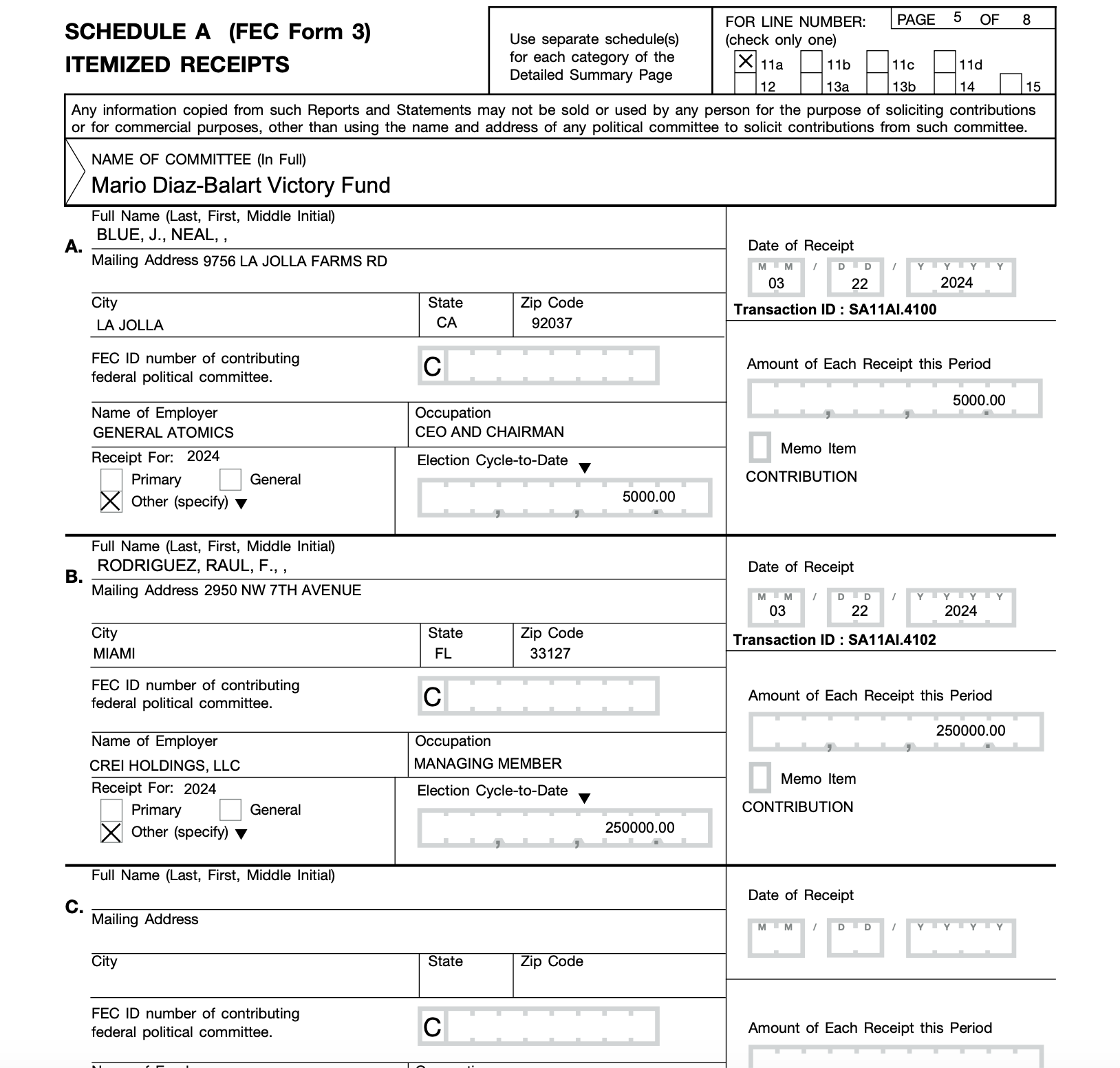
Similarly, the Mario Diaz-Balart Victory Fund accepted a $250,000 contribution from Rodriguez on March 22, 2024, 11 days after it was publicly announced that the U.S. Department of Housing and Urban Development (HUD) was poised to release $4 million in “Community Project Funding” for CREI’s Abner III.

Diaz-Balart filed his earmark request for those funds on April 29, 2022, exactly one month after Rodriguez used another company he operates, Luar LLC, to make two contributions totaling $80,000 to the National Republican Congressional Committee. But no earmarks were approved that year because a continuing resolution was used to fund the government at the prior year’s level.
‘A POLITICAL CONTRIBUTION TIED TO AN OFFICIAL ACTION’
The House Ethics Manual says a political contribution doesn’t “generally” constitute the type of “financial interest,” like owning shares of stock, that congressmen must disavow when making a request for an earmark.
“Nevertheless,” the manual says, “a political contribution tied to an official action may raise other considerations. It is impermissible to solicit or accept a campaign contribution that is linked to any action taken or asked to be taken by a Member in the Member’s official capacity – such as an earmark request that a member has made or been asked to make. Accepting a contribution under these circumstances may implicate the federal gift statute or the criminal provisions on illegal gratuities or bribery.”
Neither Rep. Gimenez nor Rep. Diaz-Balart returned multiple phone and emailed messages to their spokespersons last week requesting comment.
CREI CEO Rodriguez likewise did not return emailed and phone messages left at his office for comment.
Earmarked money secured by Diaz-Balart and Gimenez doesn’t go directly to CREI. For-profit entities like CREI are prohibited by law from receiving earmarked funds, which Congress has now rebranded as “congressionally directed spending” or “community project funding” to dodge the taint of the notorious earmark scandals in the late 1990s and early 2000s. Corruption then cost taxpayers hundreds of millions of dollars and led to the criminal convictions of several members of Congress for influence peddling.
The public outcry led Congress to ban the use of earmarks in 2011. But Congress did an about face in 2021 and that kind of “pork-barrel” spending returned and reframed as community project funding intended to reflect community priorities as identified by members of Congress.
To get around the ban on for-profit companies receiving earmarked funds, Gimenez, whose district includes much of Sweetwater and the entire Li’l Abner development site, designated Miami-Dade’s Housing and Community Development (HCD) department to receive the $6 million. CREI is the “subrecipient.”
The Abner III apartment building is described by the county as an eight-story, 326-unit affordable housing development. Approximately 40 percent, or 130 units, are to be set aside to rent to people earning no more than 80 percent of the area medium income (AMI), which for a four-person household in Miami-Dade is $87,000. The remaining 60 percent, 196 units, are to be set aside for those earning no more than 120 percent of AMI – or about $120,000 for a two-person household or $146,000 for a four-person household. Also, 40 percent of the units will be restricted to individuals 55 and older.
Abner III, located on NW 4th Terrace between NW 112 and 114 Avenues, is expected to be completed by the end of April. It was built on the heels of next door’s Abner II, CREI’s eight-story, 244-unit affordable senior housing community that the county says cost $41.4 million to build and opened in 2023. Abner I, a smaller nearby apartment building with 87 rental units for seniors, was completed in 2013.
Monthly rents for a one-bedroom apartment at Abner II start at around $1,048 and two-bedrooms from $1,263, according to ApartmentFinder.com. CREI’s website says Abner II “is constantly close to full occupancy” highlighting the area’s need for affordable housing as property values, and rents, continue to rise.
DIAZ-BALART SOUGHT $20 MILLION EARMARK
Rodriguez and CREI used no federal money to construct Abner II. But that changed dramatically beginning with Rep. Diaz-Balart’s four-sentence April 29, 2022 letter to House Appropriations Committee Chairwoman Rosa DeLauro, D-CT and Ranking Member Kay Granger, R-TX.

Diaz-Balart, a senior member of the Appropriations Committee who was named vice chair in January 2025, sought to earmark funds for “Sweetwater’s Affordable Housing Project” for fiscal year 2023. He didn’t identify the project or developer by name, describe it in any way or say how much he was asking for. Diaz-Balart’s congressional website says he requested $20 million.
Additional internal communications appear to have further enlightened the appropriations committee as to what exactly Diaz-Balart was seeking. Because eight months later, in December 2022, the Congressional Record published news that Diaz-Balart’s letter had netted $4 million in Community Project Funding for Abner III.
Also approved was another $8 million in earmarks Diaz-Balart had requested for the City of Sweetwater to pay for “necessary” road and sewer improvements to allow “for the Sweetwater Affordable Housing project.”
On May 8, 2023, Miami-Dade housing received a grant award letter from HUD with detailed instructions on the substantial paperwork that must be completed to obtain the funds, including a project narrative and a detailed budget. Then housing department director Alex Ballina signed the grant agreement on Jan. 24, 2024, assuring HUD, administrator of the funds, that everything was in order.
News soon arrived that HUD was satisfied. On March 11, Miami-Dade’s housing department published a public notice declaring its intent to ask HUD to release the $4 million to CREI for its Abner III project.
Eleven days later, on March 22, 2024, CREI boss Raul Rodriguez contributed $250,000 to the Mario Diaz-Balart Victory Fund, Federal Election Commission (FEC) records show. Miami-Dade housing paid $4 million to CREI Holdings LLC on April 16, 2025, according to county records.
The Mario Diaz-Balart Victory Fund, which he controls, is what’s known as a joint fundraising committee (JFC) that raises funds for his campaign committee, his leadership PAC and the National Republican Congressional Committee (NRCC). Many House members have JFC’s and they allow them to collect large checks from their major donors – they can give one check that gives the maximum amount to each of the JFC’s beneficiary committees. To further complicate things, a national party committee like the NRCC has an operating account and three special accounts (legal, convention, building) and a donor can give to all four.
FEC records show that the $250,000 was cut up on the same day it was received according to a predetermined “formula for allocating proceeds and expenses” that all joint fundraising committees must establish. A total of $150,000 went to the NRCC, including $108,700 to its “legal proceedings account” and $41,300 for its operations account for use in the 2024 primaries. The congressman’s principal campaign account, Mario Diaz-Balart for Congress, received the maximum it could accept, $6,600, and $5,000 went to his leadership PAC, Maintaining Republicans in Office. Most of the remaining $88,400 Raul Rodriguez donated was still in the Victory Fund as of the end of last year.
In March 2022, Rodriguez contributed $80,000 to the NRCC. He and his wife also gave the maximum to Mario Diaz-Balart for Congress in September 2021.
GIMENEZ WANTED $10 MILLION EARMARK
Rep. Gimenez’s ties to Raul Rodriguez and CREI appear to have begun in early 2024 when, according to U.S. Senate lobbying records, Gimenez co-sponsored a bill, H.R. 6321, that CREI’s Washington, D.C. lobbying firm, Atlas Crossing, was pushing. The Preservation and Reinvestment Initiative for Community Enhancement Act, or PRICE Act, was intended to increase the availability of affordable manufactured housing.
The bill went nowhere. But on May 8, 2024, Gimenez wrote to the Republican and Democratic leaders of a House appropriations housing subcommittee requesting more funding for CREI’s Abner III development for fiscal year 2025.

Gimenez’s initial earmark request went nowhere, too, because Congress used a continuing resolution to fund the government at base levels and avoid a shutdown. So again in fiscal year 2025 no earmarks were awarded.
Nearly a year later, April 10, 2025, CREI’s Rodriguez contributed $150,000 to the Gimenez Victory Committee. It is the only contribution Rodriguez made to Gimenez before or since, according to a search of federal election records.
FEC records show that on June 30 Gimenez’s joint fundraising committee transferred $26,177 to his principal campaign committee, Carlos Gimenez for Congress, $7,221 to his leadership PAC Libertad, and $124,568 to the NRCC, with most of it going to its legal proceedings account. FEC records do not make clear why that total is nearly $158,000, or $8,000 more than Rodriguez contributed.
On May 23, 2025, Gimenez sent a second letter seeking an earmark for Rodriguez and CREI’s Abner III project to Appropriations Committee Chair Tom Cole, R-OK and Ranking Democrat Rosa DeLauro of Connecticut. As before, Gimenez did not identify the Sweetwater affordable housing project by name or say how much he was seeking to help pay for it. Gimenez’s website, however, says the ask was for $10 million in fiscal year 2026.
On Feb. 3, 2026 Gimenez’s letter paid off for Rodriguez with the announcement of a slimmed down award of $6 million. The appropriation was tucked inside the huge government funding package President Trump signed to end a partial government shutdown.
To date, Miami-Dade housing has not been officially notified of the HUD grant award and no funds have been released.
Gimenez also used his earmark privilege to obtain $1.05 million in February for a “Sweetwater policing equipment and safety project,” specifically a CCTV and camera system and a license-plate reader system. He originally sought it a week before his $10-million request for Abner III in 2024 when no earmarks were awarded. Then, as CREI sought to score “bonus points” to obtain other public funds to build Abner III from Miami-Dade County, the company committed in writing to installing expensive CCTV cameras and a license-plate reader system that would be compatible with technology used by the city’s police department.
November 2024 was when CREI announced that Li’l Abner Mobile Home Park would close and that everyone had to be out by mid-May 2025. The problem for many: their “mobile” homes, which some had poured their life savings into, could not be moved.
Some residents told TV reporters they’d invested more than $100,000 in their immobile homes that sat on tiny plots rented from the park. They rejected as insufficient CREI’s buyout offer of $14,000 for those who departed by Jan. 31, 2025, or $3,000 for those who left before the end of April. Many were among about 200 residents who sued but ultimately lost.
It is noteworthy that while Congressmen Gimenez and Diaz-Balart were actively involved behind the scenes in obtaining millions of dollars in “congressionally directed spending” to make Abner III happen, neither man had any public comment as the plight of the park’s beleaguered residents played out over months in print headlines and stories on every local TV station.
Not even last October’s final reports about weeping park residents and the armed sheriff’s deputies who’d come at last to evict them could draw the congressmen out before media cameras to offer even a few political expressions of sympathy.
Of course, for Gimenez at least, it would have been particularly awkward. What words could he say to the hundreds of constituents he’d quietly sold out?





Leave a Reply